import os
import subprocess
import sys

def clean_path(path_str):
    """清理拖拽文件时终端自动添加的引号和多余空格"""
    return path_str.strip(' "\'')

def process_audio():
    # 【核心升级】判断当前是 Python 脚本运行,还是被打包成了 exe 运行
    # 确保导出的文件永远保存在程序所在的当前目录
    if getattr(sys, 'frozen', False):
        script_dir = os.path.dirname(sys.executable)
    else:
        script_dir = os.path.dirname(os.path.abspath(__file__))

    print("="*50)
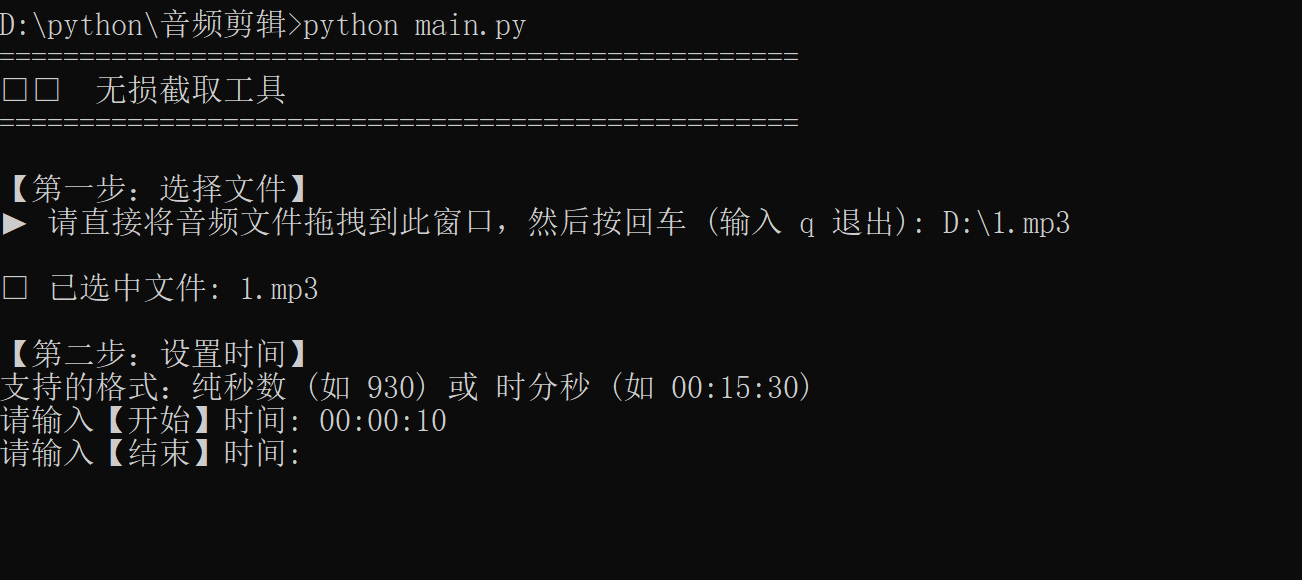
    print("⚖️  无损截取工具 ")
    print("="*50)

    while True:
        print("\n【第一步:选择文件】")
        user_input = input("▶ 请直接将音频文件拖拽到此窗口,然后按回车 (输入 q 退出): ").strip()

        if user_input.lower() == 'q':
            break

        if not user_input:
            continue

        input_path = clean_path(user_input)

        if not os.path.exists(input_path):
            print(f"❌ 找不到文件:{input_path},请重新拖拽!")
            continue

        print(f"\n✅ 已选中文件: {os.path.basename(input_path)}")

        # 获取开始和结束时间
        print("\n【第二步:设置时间】")
        print("支持的格式:纯秒数 (如 930) 或 时分秒 (如 00:15:30)")
        start_time = input("请输入【开始】时间: ").strip()
        end_time = input("请输入【结束】时间: ").strip()

        if not start_time or not end_time:
            print("❌ 时间不能为空,请重新开始。")
            continue

        # 自动生成导出文件名 (保存在程序同级目录)
        base_name, ext = os.path.splitext(os.path.basename(input_path))
        safe_start = start_time.replace(':', '')
        safe_end = end_time.replace(':', '')
        output_filename = f"{base_name}_截取_{safe_start}至{safe_end}{ext}"
        output_path = os.path.join(script_dir, output_filename)

        print("\n【第三步:开始无损截取...】")
        command = [
            "ffmpeg",
            "-i", input_path,
            "-ss", start_time,
            "-to", end_time,
            "-c", "copy",
            "-y",  # 如果文件已存在则覆盖
            output_path
        ]

        try:
            # 执行 FFmpeg 命令
            subprocess.run(command, check=True, stdout=subprocess.PIPE, stderr=subprocess.PIPE)
            print(f"🎉 截取成功!")
            print(f"📁 文件已无损保存至: {output_path}")
        except FileNotFoundError:
            print("❌ 致命错误:系统中未找到 FFmpeg!")
            print("请确保已将 ffmpeg.exe 与本程序放在同一文件夹下,或配置了环境变量。")
        except subprocess.CalledProcessError as e:
            print(f"❌ 截取失败,FFmpeg 报错:\n{e.stderr.decode('utf-8', errors='ignore')}")

        print("\n" + "-"*50)

if __name__ == "__main__":
    try:
        process_audio()
    except KeyboardInterrupt:
        print("\n已退出程序。")
        sys.exit(0)